I arrived in North Cyprus in the middle of the night, having landed in the southern part of the island and crossed into the north on foot. It was one of those journeys that makes you conscious of geography in a way you rarely are when travelling between countries. There was a United Nations sign marking the divide. I half expected to see military vehicles, perhaps UN personnel or some visible indication of the tensions that have shaped this island for decades. There was none that I could see.
First, I handed my passport to a Greek Cypriot border officer. Four steps later, I handed it to a Turkish Cypriot officer. Two passport checks, a few steps of pavement, and I was in a different political reality.
I had imagined that crossing might feel unsettling, perhaps even a little dangerous. Surprisingly, it didn’t. It was quiet, almost uneventful. The people I encountered on both sides were friendly, smiling and welcoming. It struck me that, despite the political significance attached to those few metres, the human interaction was entirely ordinary. A smile, a passport, a polite exchange. Sometimes the contrast between the way we organise the world and the way people actually experience one another is difficult to ignore.
It was too dark to appreciate the landscape on the drive to my hotel. I went to sleep knowing very little about what surrounded me. The following morning, however, the island introduced itself.
On one side stood the magnificent Beşparmak Mountains, their rugged peaks stretching across the horizon and embracing the landscape almost protectively. On the other was the Mediterranean, an extraordinary expanse of turquoise, its colour changing with the light. The mountains seemed to cradle the land while the sea opened it to the world. It was one of the most beautiful settings I had woken up to in a very long time.
After London’s cold, grey and rather relentless weather, the warmth was particularly welcome. Twenty four degrees, a generous sun and a sky that seemed to have forgotten what clouds were felt like a small act of kindness from the universe. I hadn’t realised quite how much I needed it.
There has been a great deal to navigate recently, and two particularly difficult events lie ahead, one towards the end of this month and another towards the end of next. I know that neither will be easy. For now, I wanted a little distance from the familiar, a change of scenery and, perhaps more importantly, some room to breathe.
I haven’t entirely succeeded in escaping work. My laptop has become my permanent travel companion, and emails, calls and deadlines have followed me here too. But there is a difference between answering emails in a London office while watching the rain fall and doing the same from a rooftop terrace in Beylerbeyi, or Bellapais, with the Beşparmak Mountains rising behind me, the Mediterranean stretching into the distance and the historic presence of Bellapais Abbey nearby. Add a cup of Turkish tea, and even the most uninspiring email seems marginally more manageable.
The work hasn’t changed. The perspective has.
Yesterday, I decided to climb towards Buffavento Castle, one of the most spectacular and inaccessible historic fortresses in Cyprus. Perched at approximately 954 metres above sea level in the Beşparmak Mountains, it is the highest of the island’s three famous mountain castles. Its name, derived from Italian, is generally translated as “Defier of the Winds”. Standing up there, I could understand why.
The climb was considerably more demanding than the photographs might suggest. The path became steeper, the steps seemed endless, and the air felt thinner as I gained altitude. But every time I stopped to catch my breath, the landscape offered another reason to forget the discomfort. The views were extraordinary, stretching across the island, with the Mediterranean and the surrounding mountains creating a panorama that was difficult to take in all at once.
I found myself looking at the landscape with something approaching disbelief. There is an extraordinary artistry in the natural world, regardless of how one understands the origins of creation. The precision of its detail, the interplay of light and shadow, the shapes and textures that emerge over geological time, the way apparently random elements come together to create something so harmonious. It is difficult to look at all this and not feel a profound sense of wonder. Human creativity is remarkable, but nature operates on a scale and with an imagination that we can only begin to comprehend.
And then there were the ruins.
Buffavento was not an isolated fortress. Together with St Hilarion and Kantara, it formed part of a chain of Byzantine strongholds along the mountain range. Their elevated positions allowed sentries to observe approaching ships and potential threats along the coast. Warnings could be transmitted between the castles and towards Nicosia using signals and fires. It was an ingenious system, particularly given the terrain and the technological limitations of the time.
I found myself thinking about the extraordinary ingenuity, effort and resources that human beings have devoted to defending themselves against one another. Imagine transporting materials, building walls and constructing a fortress at almost a thousand metres above sea level, on such difficult terrain, with the purpose of watching for danger. How deeply must fear have shaped the lives of those who built it? How much human creativity has historically been directed towards anticipating threats, protecting territory and preparing for conflict?
Centuries later, the military purpose has disappeared. The sentries are gone, the fires no longer signal danger, and the fortress stands largely in ruins. What remains is the extraordinary landscape it once commanded. There is something rather poignant about that transformation.
I should admit that, somewhere near the top, I experienced a moment of genuine hesitation. The height, the steepness and a little vertigo made me question whether continuing was such a good idea. I paused, looked around, gathered myself and carried on. I made it to the top, and the view was worth every uncomfortable step.
Yet it was not only the scenery that stayed with me. The ruins seemed to invite questions about the relationship between fear, power and the human instinct for survival. How much of what we build, individually and collectively, is an expression of what we are afraid of losing? And how much of our history is really the story of people trying to secure themselves against other people?
There is also something quietly familiar about life on both sides. The food, the music, the warmth of hospitality and certain expressions of the human spirit seem to cross the divide rather effortlessly. Different histories, different experiences and deeply held identities, certainly, but also so much that feels shared. Both communities have known loss, fear and displacement, and I found myself wondering whether, beneath the political narratives and the weight of inherited memories, there is a simpler human longing that doesn’t receive nearly enough attention: the wish to live peacefully, without suspicion or fear of one another, to share a meal, enjoy the music, welcome a neighbour and perhaps, one day, simply embrace. I may be wrong. I would never presume to speak for people whose experiences I can only begin to understand. But I couldn’t quite shake the feeling that ordinary human connection might be considerably less complicated than the history and politics that stand between people.
There is something else I have noticed everywhere on this island: olive trees. They are scattered across the landscape, growing alongside roads, on hillsides, in fields and around old buildings. They are not particularly spectacular in the conventional sense of the word. Their trunks are often twisted and gnarled, their leaves a muted silvery green, and their appearance can be almost austere. They don’t compete for attention. They don’t seem particularly interested in being admired. Yet the more I look at them, the more fascinated I become.
I recently read about their extraordinary longevity. Olive trees are among the longest lived cultivated trees in the world. While their precise ages are often difficult to establish, some have survived for many centuries, and a small number of exceptionally old specimens may be approaching or exceeding a thousand years. Their trunks can become hollow with age, while new growth continues to emerge. There is something remarkable about a living organism that can lose so much of its original structure and still carry on growing.
And I began to think about what these trees must have witnessed.
Cyprus has been home to olive cultivation for thousands of years. The trees have been here through the rise and fall of empires, through Byzantine, Lusignan, Venetian and Ottoman rule, through British administration, independence, conflict and division. They have stood through wars, invasions, changing borders, changing languages, changing currencies and generations of people whose lives have unfolded beneath their branches. The island has changed its political identity many times, but the olive trees have continued to grow.
I found myself attributing a rather human quality to them. They seem entirely indifferent to the noise around them. They don’t expend their energy worrying about what the neighbouring tree thinks, or whether the landscape on the other side of an invisible boundary belongs to somebody else. They don’t seem concerned with which flag flies above them, which language is spoken in their shade or which currency changes hands in the nearby market. They simply do what they have always done: put down roots, draw nourishment from the earth, withstand the elements and produce something that people across cultures and generations have valued.
They don’t take sides. They don’t inherit grievances. They don’t distinguish between people according to the language they speak or the identity they carry. Their fruit is harvested, pressed into oil, shared at tables and used in the kitchens of people whose histories and politics may be very different. The olive has been part of Mediterranean life for millennia, nourishing people long before many of the borders and political identities we recognise today came into existence.
Of course, trees do not possess human indifference or moral wisdom. I know I am projecting something of my own thoughts onto them. But perhaps that is precisely why I find them so compelling. Looking at their ancient, weathered forms, I cannot help wondering whether we humans sometimes make life unnecessarily complicated. We invest so much energy in defining ourselves against others, protecting our identities, defending our positions and preserving divisions. Meanwhile, these trees carry on, quietly and productively, outliving the arguments that once seemed so important.
There is a lesson in their endurance, even if it is one we have to provide ourselves.
Perhaps strength is not always about resisting, fighting or building higher walls. Perhaps sometimes it is about putting down deep roots, adapting to changing circumstances and continuing to give something of value to the world, without needing to announce your presence.
I think I have developed a particular affection for these rather unassuming trees. They may not be the most visually striking feature of the Cypriot landscape, but they have become one of the things I will remember most.
The olive trees also made me think differently about the history of this island. Their presence is a reminder that the land has a continuity that political events, however consequential, cannot entirely erase.
I had started reading about Cyprus, and the history is both complicated and deeply affecting. The island gained independence from British rule in 1960, but the political arrangements intended to accommodate its Greek Cypriot and Turkish Cypriot communities soon came under severe strain. Intercommunal violence erupted in 1963, leading to the separation of communities and the establishment of a United Nations peacekeeping presence in 1964. A decade later, in 1974, a coup backed by the Greek military junta, seeking union with Greece, was followed by Turkey’s military intervention. The island was divided, and large numbers of people were displaced from their homes.
The United Nations buffer zone, commonly known as the Green Line, still separates the two parts of the island. In 1983, the Turkish Cypriot administration declared the Turkish Republic of Northern Cyprus, which is recognised as a state only by Türkiye. The Republic of Cyprus remains the internationally recognised government of the island.
These are the political facts, but they tell only part of the story. Behind every date and diplomatic position are people who lost homes, communities, relatives and the familiarity of places they had once taken for granted. Some have spent decades unable to return to the places where they grew up. Others have inherited memories of a conflict they were too young to experience themselves.
In speaking to people here, I was struck by how present the past remains. History is not necessarily something that recedes simply because the world has moved on to another headline. It survives in conversations, in family memories, in the things people remember and in the things they have never quite been able to forget. The experiences and political perspectives on either side are not identical, and the history cannot be reduced to a simple story of two communities with one shared interpretation. But the human consequences are unmistakable.
I kept returning to a question that has troubled me long before I came to Cyprus. Why is it so often ordinary people who bear the greatest consequences of decisions made by those in positions of authority? Why should people lose their homes, their families, their sense of belonging or decades of their lives because of political ambitions, competing nationalisms, ideological convictions or failures of leadership? Why do the consequences of decisions made in rooms of power so often find their way into the kitchens, bedrooms and childhood memories of people who had no part in making them?
I don’t pretend to have answers, and a few days on an island cannot provide an understanding of a history that generations have lived through. But perhaps travelling should involve more than admiring beautiful places. It should also make us curious about the lives that have unfolded within them, the histories that have shaped them and the people whose experiences are often missing from the grand political narratives.
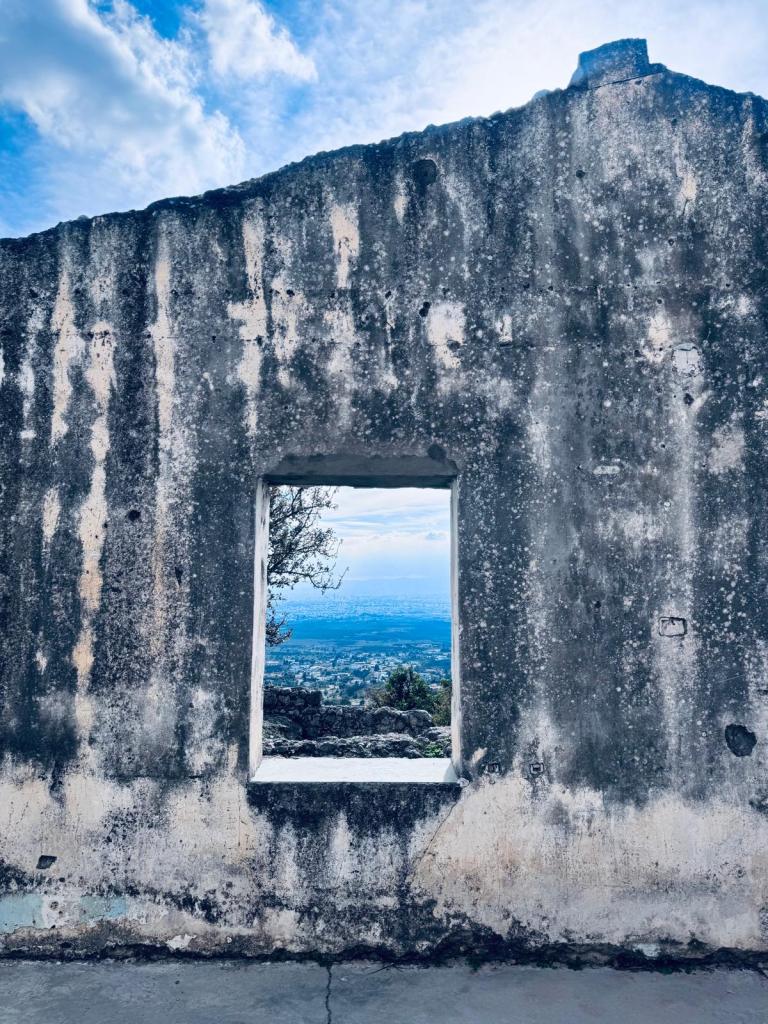
There is one particular image from my visit that has stayed with me more than anything else. It is the photograph accompanying this piece, taken among the remains of an old religious building high in the mountains. What survives is little more than a grey stone structure, exposed to the elements. There is no roof, no glass in the windows and very little left of the building that once existed. Yet one window frame remains, opening onto a landscape of almost unbelievable beauty.
I stood looking through it for quite some time. The contrast was extraordinary. The building had lost almost everything that once made it a building, yet the window still framed something magnificent. Through its weathered stone edges, the mountains and the surrounding landscape appeared almost like a painting. It was difficult to decide whether I was looking at a window that had survived the destruction of a building or at a frame that had finally been freed from the limitations of the walls around it.
I began to wonder what that window might have witnessed. Who had looked through it? What had they seen? What had they prayed for? What had frightened them? What had given them hope? Perhaps people had once stood in exactly that spot, looking at the same mountains, seeking comfort, shelter or answers to questions that were no less human than ours.
Today, the walls are grey and broken, the roof has disappeared, and the building has surrendered to time. Yet the view remains. And somehow, the absence of everything around the window makes the landscape beyond it even more powerful.
I found myself thinking about borders again. About how much of our understanding of the world is shaped by the frames through which we look at it. We inherit histories, identities, loyalties and fears. We learn where one side ends and another begins, sometimes long before we are old enough to question why. We can become so accustomed to looking through a particular frame that we forget there is an entire landscape beyond it.
Perhaps that is what this window was telling me. Not that history should be forgotten, or that divisions and suffering can simply be wished away, but that there is always more to see than the boundaries immediately in front of us. That understanding another person’s perspective does not require us to abandon our own. That beauty and pain can exist in the same place, and that acknowledging one should never require us to deny the other.
I came to North Cyprus needing a break. I wanted sunshine after London’s grey skies, warmth after the cold, and a little distance from the difficult things waiting for me at home. I found all of that, and considerably more. I found mountains that made me feel small, a castle that made me think about the long history of human fear, olive trees that seemed to embody a quieter kind of strength, conversations that reminded me that the past is never quite past, and a window that I suspect I will remember long after I have forgotten the details of the journey.
The two difficult events waiting for me will still be there when I return. Nothing has been resolved simply because I have travelled somewhere beautiful. But perhaps I don’t need everything to be resolved right now. Perhaps it is enough to have found a little space in which to think, to breathe and to see things from a different vantage point.
I keep thinking about that empty window. A structure stripped of almost everything, yet still offering a view that takes your breath away. And I think about the olive trees, standing quietly across this island, continuing to grow while the world around them changes. One has lost almost everything but still frames extraordinary beauty. The others have endured for centuries, giving something back to the world without demanding anything in return.
Perhaps there is a connection between the two that I hadn’t anticipated when I arrived. Both remind me that what matters is not necessarily what we manage to preserve, possess or defend, but what remains meaningful despite the passage of time and everything that happens around us.
The castle was built to watch for danger. The island’s borders were shaped by conflict. The ruins bear witness to the passing of centuries. Yet the mountains remain, the sea continues to shimmer in the sunlight, and the olive trees continue their quiet work. Through an empty window, the world is still breathtakingly beautiful.
I think I will remember that view for a long time.


Leave a Reply